
Fully Bonded and Insured
License# 17157
How Commercial EV Charger Installation Helps Businesses
March 2, 2026
Discover how Commercial EV Charger Installation boosts revenue, ensures compliance & maximizes ROI for NJ businesses. Get your guide now!
Why Commercial EV Charger Installation is Essential for Modern Businesses
Commercial EV charger installation is the process of planning, permitting, and deploying electric vehicle charging infrastructure at business locations, from retail centers and office buildings to fleet depots and multi-family properties. Here's what businesses need to know:
Quick Overview: Commercial EV Charger Installation
- Why Install? Attract EV-driving customers, retain employees, generate revenue, and meet sustainability goals
- Charger Types: Level 2 (4-10 hours, ideal for workplaces) vs. DC Fast Charging (80% charge in 30-60 minutes, ideal for retail)
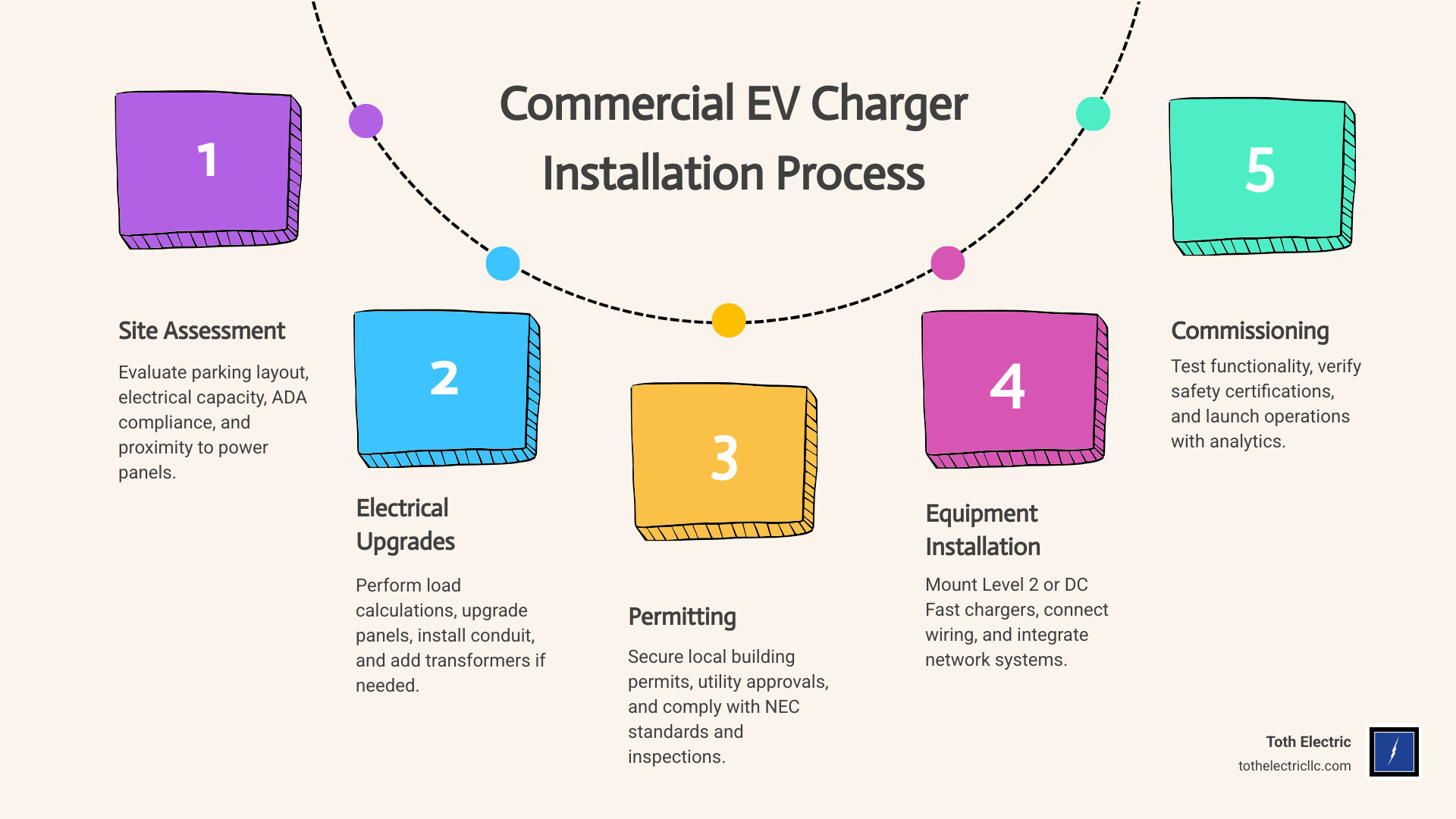
- Installation Process: Site assessment → electrical upgrades → permitting → equipment installation → utility inspections → commissioning
- Typical Costs: $800-$9,000+ per Level 2 charger; $20,000-$100,000+ for DC Fast Chargers (before incentives)
- Available Incentives: Up to $100,000 federal Alternative Fuel Vehicle Refueling Property Credit; NJ-specific PSE&G rebates and state programs
- Timeline: 2 weeks to 6+ months depending on scope, electrical upgrades, and permitting requirements
The numbers tell a compelling story: EV sales in 2023 were six times higher than in 2018 according to the International Energy Agency. Meanwhile, 70% of Gen Zers and Millennials actively try to reduce their environmental impact, and sales of products with sustainability claims continue to outpace those without. This shift creates an infrastructure gap that forward-thinking businesses are addressing through commercial EV charger installations—not just to meet demand, but to gain competitive advantage through destination charging that increases customer dwell time and generates additional revenue streams.
Yet, installing commercial EV charging infrastructure involves far more complexity than residential installations. Businesses must navigate electrical capacity assessments, demand charges, utility coordination, ADA compliance, permitting requirements, and decisions about networked vs. standalone systems. They need to choose between Level 2 chargers for extended parking scenarios and DC Fast Chargers for quick turnaround needs, while planning for scalability as EV adoption accelerates. The electrical work alone can account for 40% or more of total installation costs, making proper planning and load management critical to project success.
I'm Jordan Toth, I'm master electrician and owner of Toth Electric in Northern New Jersey. I've guided businesses through the complete commercial EV charger installation process. Whether you're installing a single Level 2 charger for employee use or deploying multiple DC Fast Chargers for customer-facing locations, this guide will walk you through every technical requirement, financial consideration, and regulatory compliance step you need to know for a successful Commercial EV Charger Installation project.
Why Businesses Need Commercial EV Charger Installation
In Northern New Jersey, we are seeing a massive shift in how people travel. Whether you operate a retail storefront in Montclair or an office complex in Morristown, your parking lot is becoming a critical service hub. The demand for EV charging is skyrocketing.
Installing EV chargers isn't just about being "green"; it's a strategic business move. Sales of products with sustainability claims are up compared to those without, showing that consumers are voting with their wallets. For businesses, this translates into several key advantages:
- Customer Loyalty: EV drivers plan their trips around where they can charge. If your business offers a reliable plug, you become the preferred destination.
- Employee Retention: As more people switch to EVs, workplace charging becomes a high-value perk. It helps attract top talent who want the convenience of charging while they work.
- Property Value: Adding modern infrastructure increases the appraisal value of your commercial property and makes it more attractive to future tenants.
- Brand Image: It signals to the community that you are forward-thinking and committed to sustainability goals, aligning with the values of 70% of Gen Z and Millennial consumers.
By understanding why you need commercial EV charging station installation, you can position your business as a leader in the local market.
Revenue Generation and Customer Retention
One of the most exciting aspects of Commercial EV charger installation is the potential for passive income. Businesses can set custom tariffs, allowing them to recover electricity costs or even generate a profit.
- Custom Tariffs: You decide what to charge. You might offer free charging for the first hour to attract shoppers, then switch to a paid model.
- Increased Dwell Time: When a customer plugs in, they are likely to spend more time—and more money—at your establishment.
- Advertising Revenue: Some chargers come equipped with "Media Chargers" or screens that can display advertisements, creating an additional revenue stream.
By providing commercial EV charging stations, you gain a competitive advantage that "standard" parking lots simply can't match.
Equipment and Technical Requirements for Commercial Sites
Choosing the right hardware is the foundation of a successful project. We always recommend looking for ENERGY STAR-certified equipment to ensure long-term efficiency and durability.
| Feature | Level 2 Charger | DC Fast Charger (DCFC) |
|---|---|---|
| Voltage | 208V - 240V | 480V+ (Three-Phase) |
| Charging Speed | ~40 miles of range per hour | ~200 miles of range in 1 hour |
| Best Use Case | Workplaces, Hotels, Apartments | Retail, Highway Stops, Fleets |
| Connector Type | J1772 | CCS or NACS (Tesla) |
| Installation Cost | Lower ($600 - $9,000+) | Higher ($20k - $100k+) |
Choosing Between Level 2 and DC Fast Charging
The decision usually comes down to "dwell time." How long do people stay at your site?
- Workplaces & Multi-Family: Level 2 is the gold standard. Employees and residents are parked for 4-8 hours, which is plenty of time for a full charge at 208-240V.
- Retail & Quick Service: If your customers are in and out in 30-60 minutes, Level 3 DC Fast Charging is required to provide a meaningful boost in range.
Site Suitability and Accessibility
When we assess a site in areas like Jersey City or Newark, we look at more than just the electrical panel. Accessibility is a legal requirement. Per the US Access Board ADA compliance guidelines, a portion of your charging bays must be accessible to people with disabilities.
Other site factors include:
- Proximity to Panels: The closer the charger is to your commercial electrical room, the lower your trenching and wiring costs will be.
- Lighting and Safety: Chargers should be in well-lit areas with clear signage to prevent "ICE-ing" (internal combustion engine vehicles blocking charging spots).
The Commercial EV Charger Installation Process
Installing a commercial system is a multi-step journey that requires expert commercial electrician services. At Toth Electric, we follow a rigorous process to ensure every EV charger installation is safe and compliant.
- Site Validation: We inspect your existing infrastructure to see if your current service can handle the new load.
- Engineering & Design: We create a site plan, including riser diagrams and load sheets for the utility company.
- Permitting: We handle the paperwork with local NJ municipalities to ensure the project meets all building codes.
- Construction: This involves trenching, running conduit, mounting pedestals, and wiring the units.
- Commissioning: We test the software and hardware to ensure the "handshake" between the charger and the vehicle is seamless.
Planning Your Commercial EV Charger Installation
Planning starts with getting internal buy-in. You'll need to coordinate with stakeholders, property managers, and your local utility provider (like PSE&G or JCP&L). A successful commercial EV charging station installation depends on accurate load calculations and early communication with the utility to avoid delays in service upgrades.
Electrical Infrastructure and Panel Upgrades
Many older commercial buildings in Northern NJ weren't designed with EV charging in mind. Often, commercial electrical panel upgrades are necessary to handle the increased demand.
- Transformer Capacity: We may need to coordinate with the utility to provide a larger transformer.
- Load Management: Technologies like PowerFlex can save up to 60% on implementation costs by intelligently distributing power between chargers, preventing the need for massive (and expensive) service upgrades.
Scaling Your Commercial EV Charger Installation
Don't just think about today; think about five years from now. We advocate for "future-proofing" by installing extra conduit and "passive wiring" during the initial construction. This allows you to add more chargers later without digging up your parking lot again. Use management platforms to track analytics—knowing how your stations are used helps you plan the perfect time to scale.
Financial Planning: Costs, Incentives, and ROI
Understanding how much a commercial EV charging station costs is vital for your ROI projections.
Typical Cost Breakdown:
- Equipment: $2,500 - $6,000 for a dual-port Level 2; $20,000+ for DCFC.
- Installation: Varies wildly based on trenching needs and panel capacity.
- Operational Costs: Expect roughly $300/year per port for networking fees and $400/year for maintenance.
Grants, Rebates, and Tax Credits
The good news is that you don't have to shoulder these costs alone. There are significant incentives available for New Jersey EV charger installation:
- Federal Tax Credit: The Alternative Fuel Vehicle Refueling Property Credit offers businesses up to $100,000 for eligible installations.
- PSE&G Make-Ready Program: This is a game-changer for NJ businesses. It can cover a significant portion of the "behind the meter" costs (wiring, trenching, panels) needed to support chargers.
- NJ State Rebates: Various programs through the NJ DEP and BPU offer grants for workplace and public charging.
Permits, Regulations, and Compliance
Navigating NJ building codes is where we excel. Every town—from Maplewood to South Orange—has slightly different requirements. We ensure your installation meets the National Electrical Code (NEC) and all local safety standards. This includes ensuring chargers aren't tripping hazards and that they are properly grounded and protected from power surges.
Frequently Asked Questions
How much does it cost to install a commercial EV charger?
While a simple Level 2 unit might cost $1,500 to install in an ideal spot, a full commercial EV charging station installation typically starts around $6,000 and can go up significantly if trenching or major panel upgrades are required. However, incentives often cover 50% to 100% of these costs.
What is the difference between Level 2 and DC Fast Charging for businesses?
Level 2 uses 240V power (like a clothes dryer) and is perfect for locations where cars stay for hours. DC Fast Charging uses 480V and bypasses the car's onboard charger to dump power directly into the battery, making it much faster but significantly more expensive to install.
Are there incentives for NJ businesses installing EV chargers?
Yes! Between the federal tax credit and the PSE\&G Make-Ready program, many NJ businesses find that their out-of-pocket costs are remarkably low. We also provide home installation of EV chargers in New Jersey if you are a business owner looking to charge your company vehicle at your residence.
Conclusion
Investing in Commercial EV charger installation is a clear signal that your business is ready for the future. By attracting high-value customers, retaining top talent, and leveraging available NJ incentives, you can turn your parking lot into a profit center.
At Toth Electric, we pride ourselves on doing the job right and treating people right. As a licensed electrical contractor serving Northern New Jersey—including Union, West Orange, Verona, and Mountainside—we have the expertise to handle your project from the first load calculation to the final utility inspection.
If you're ready to lead the way in sustainability and customer service, EV charging is the place to start. Contact us today to discuss your commercial EV charging station installation, and let’s get your business powered up for the road ahead.
Read Our Best Articles


Serving Communities Throughout Northern New Jersey
Mountain Lakes, South Orange, West Orange, Mountainside, Morristown, Maplewood, New Providence, Newark, Union County, Montclair, Verona, and surrounding Northern New Jersey communities.


