
Fully Bonded and Insured
License# 17157
Power to the People: A Guide to House Generator Prices
February 24, 2026
Discover house generator prices: $7K-$15K installs, sizes, brands, fuel costs & ROI. Get NJ quotes now!
Why Understanding House Generator Prices Matters for Northern New Jersey Homeowners
House generator prices range from $7,000 to $15,000 for a complete whole-house installation, but understanding what drives those costs can save you thousands and help you make the right choice for your home.
Quick Price Overview:
| Generator Size | Equipment Cost | Installation Cost | Total Installed Cost |
|---|---|---|---|
| 10-14 kW (Essentials) | $3,779 - $4,899 | $3,000 - $5,000 | $7,000 - $10,000 |
| 20-22 kW (Whole House) | $5,500 - $7,249 | $3,000 - $5,000 | $10,000 - $14,000 |
| 24-26 kW (Full Coverage) | $7,249+ | $5,000 - $8,000 | $12,000 - $16,000+ |
What the Total Cost Includes:
- Generator unit (varies by capacity and brand)
- Automatic transfer switch ($500 - $2,500)
- Concrete pad installation (~$1,000)
- Professional electrical wiring and connections
- Fuel line installation ($500 - $2,000)
- Permits and inspections ($100 - $500)
- Labor and site preparation ($3,000 - $5,000)
Power outages in Northern New Jersey aren't just inconvenient—they can cost homeowners up to $14,000 in losses from spoiled food, frozen pipes, flooded basements from failed sump pumps, and emergency hotel stays. Whether you're facing severe storms, aging grid infrastructure, or simply want peace of mind for medical equipment or home-based work, a backup generator is no longer a luxury—it's a practical investment in your family's safety and comfort.
But generator pricing can feel like a black box. Why does one 20 kW system cost $10,000 installed while another runs $16,000? What are you actually paying for beyond the metal box sitting on the concrete pad? And how do you know if you're getting a fair price or overpaying?
This guide breaks down every component of house generator pricing so you can budget accurately, compare quotes intelligently, and understand exactly what you're buying. We'll cover how generator size, fuel type, installation complexity, and regional factors specific to Northern New Jersey all impact your final investment. Whether you need essential backup power for your furnace and refrigerator or whole-house coverage for every comfort and convenience, you'll learn what to expect and how to get the best value.
Factors Influencing House Generator Prices
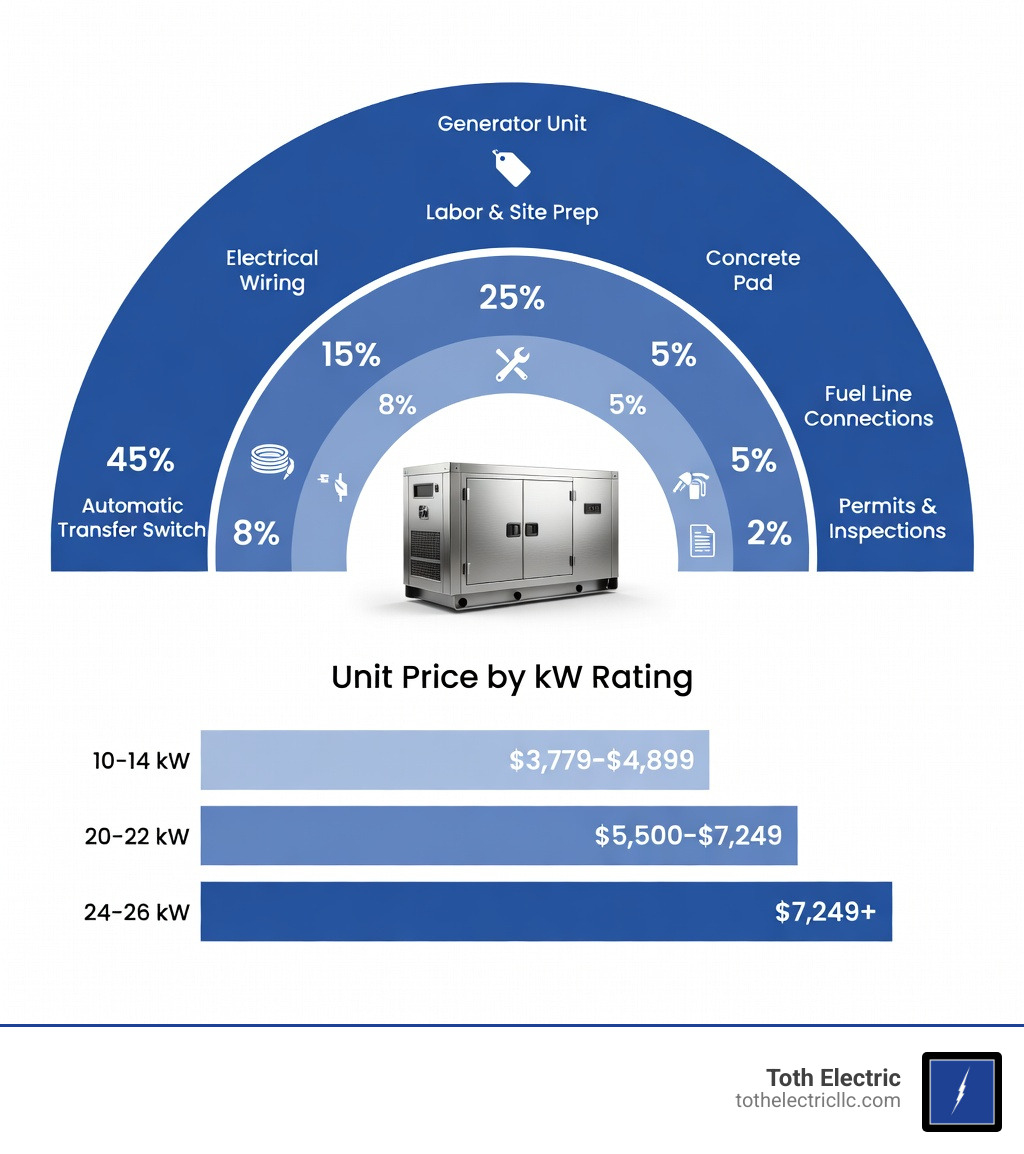
When you start looking at house generator prices, it is easy to get "sticker shock" if you only look at the unit price on a website. In reality, the generator unit itself is often only about 40% to 50% of the total investment. At Toth Electric, we want our neighbors in places like Montclair and Morristown to understand that several moving parts dictate the final invoice.
The primary drivers of the total cost include:
- The Unit Capacity: Naturally, a 26kW unit costs more than a 10kW unit.
- The Transfer Switch: This is the "brain" that tells the generator to kick in.
- Site Preparation: Does the ground need leveling? Do we need to clear brush?
- Fuel Line Distance: The farther your gas meter is from the generator location, the higher the installation cost will be due to additional piping and labor.
- Electrical Complexity: Upgrading an old electrical panel to accommodate the new system adds to the labor.
For a deeper dive into these variables, you can read more about whole-house generator installation costs.
Component Cost Breakdown
To help you visualize where your money goes, here is a breakdown of the essential components required for a safe, code-compliant installation:
- Automatic Transfer Switch (ATS): $500 – $2,500. This is non-negotiable for a standby system. It prevents "back-feeding" the grid, which is a major safety hazard for utility workers.
- Concrete Pad: ~$1,000. A 3x6 ft pad is standard. It must be level and sturdy to prevent the unit from shifting or vibrating out of place.
- Battery Kits: $150 – $300. Your generator needs a battery to start, just like your car.
- Enclosure Materials: Standard aluminum or steel enclosures are usually included, but high-corrosion or high-wind areas might require premium materials.
- Permit Fees: $100 – $500 depending on your specific town (e.g., Jersey City vs. New Providence).
You can find more info about transfer switch installation to understand why this specific component is so vital for your home's safety.
Regional Variations in House Generator Prices
Living in Northern New Jersey means we deal with unique cost factors. Labor rates in our area are higher than the national average, reflecting the high level of expertise required to navigate NJ's strict building codes.
Towns like South Orange, Maplewood, and Summit often have specific municipal permits and zoning requirements regarding where a generator can be placed (setback requirements). Furthermore, utility requirements from PSE&G or JCP&L might necessitate a gas meter upgrade to ensure the generator has enough pressure to run at full load. You can check our specific NJ Generator Installation Prices for more localized data.
House Generator Prices by Size and Capacity
Sizing is the most critical step in the process. If you buy a unit that is too small, it will stall when your AC tries to kick on. If it's too large, you’re wasting money on fuel and equipment you don’t need.
| Rating (kW) | Typical MSRP | Best For... | Home Size Suitability |
|---|---|---|---|
| 10kW | $3,779 | Essentials (Fridge, Lights, Sump Pump) | Small homes / Condos |
| 14kW | $4,899 | Essentials + 1 AC Unit | 1,500 - 2,000 sq. ft. |
| 20kW | $5,500 | Whole House (Standard) | 2,000 - 2,500 sq. ft. |
| 22kW | $6,200 | Whole House + High-End Appliances | 2,500 - 3,000 sq. ft. |
| 26kW | $7,249 | Large Estates / Heavy Medical Needs | 3,000+ sq. ft. |
For a professional assessment of your specific needs, visit our page for more info about generator sales and sizing.
How Size Impacts House Generator Prices
The "kW" rating refers to how much power the generator can produce at once. We look at your "essential loads" (the things that must stay on) versus your "total loads."
If you have a large HVAC system, a well pump, or a heated pool, your power surge capacity needs will be higher. This is especially important for our clients in Mountain Lakes; you can learn more about why certain homes benefit from specific sizes in that community. Additionally, if you rely on medical equipment like oxygen concentrators or refrigerated medications, we always recommend a slightly larger buffer to ensure 100% reliability.
Comparing Brand Price Points
While we specialize in high-quality installations, we recognize that different brands offer different value propositions.
- Entry-Level (Air-Cooled): These are the most common for residential use. They use fans to stay cool and are generally more affordable ($3,000 – $7,000 for the unit).
- Premium (Liquid-Cooled): These use an internal radiator system (like a car). They are much quieter and last longer but can cost $15,000+ for the unit alone. They are typically reserved for very large estates or commercial buildings.
When comparing brands, look beyond the MSRP. Consider the warranty value and the availability of local service technicians. You can read more about the top generator benefits to see how premium brands stack up in our local environment.
Comparing Standby vs. Portable House Generator Prices
If the house generator prices for a standby system are currently out of reach, many homeowners consider portable options. However, there is a massive difference in both price and performance.
- Portable Generators: $500 – $2,500. These require you to be home, drag the unit out of the garage, fill it with gasoline, and manually start it.
- Standby Generators: $7,000 – $15,000 (Installed). These are permanently installed, run on your home’s natural gas or propane, and start automatically within seconds of a power failure.
For those curious about the mechanics, we have more on how portable generators work. If you go the portable route, you still need a safe way to connect it to your home. Check out our ultimate guide to portable generator transfer switches to learn about manual interlock kits and transfer switches.
Long-Term Value and Home Equity
A standby generator isn't just an expense; it's an investment in your property value. Real estate experts in Northern NJ often note that homes with a "whole-house backup" sell faster and for a premium.
Beyond resale, there are immediate financial perks:
- Insurance Discounts: Some insurers offer a 5-10% discount on homeowners' insurance because a generator prevents costly water damage from failed sump pumps.
- Tax Deductions: If a generator is a medical necessity (e.g., for life-support equipment), it may be tax-deductible. Always consult a tax professional!
- Business Continuity: If you work from home in Newark or Jersey City, a generator pays for itself by preventing lost billable hours during a blackout.
Learn more about the importance of installing a standby system in Northern New Jersey homes to see how it protects your equity.
Installation and Ongoing Operational Costs
The "hidden" side of house generator prices involves the labor and materials required to make the unit functional.
A professional installation usually involves 8 to 16 hours of labor. This includes:
- Mounting the unit on the pad.
- Wiring the ATS into your main electrical panel.
- Running gas piping (and potentially trenching if the unit is far from the meter).
- Final testing and "simulated" power failure checks.
We highly recommend hiring a professional electrician for this. DIY generator installation is dangerous and can void your warranty.
Fuel Type and Running Costs
How much does it cost to actually use the generator?
- Natural Gas: This is the most popular in Northern NJ because it never runs out. You'll spend roughly $1.50 – $3.00 per hour ($36 – $72 per day) depending on the load.
- Liquid Propane (LP): Used in more rural areas where natural gas isn't available. It is slightly more expensive, averaging $2.50 – $4.00 per hour ($60 – $96 per day). You will also need to consider the cost of tank leasing or purchasing a 500-gallon tank ($1,000 – $2,500).
- Diesel: Mostly for commercial use. It is the most expensive to run but provides the highest torque for heavy machinery.
Maintenance and Servicing Expenses
Like a car, a generator needs regular "oil changes." If you don't maintain it, it won't start when you need it most.
A typical maintenance schedule includes:
- Annual Service: $150 – $300. Includes oil change, filter replacement, and spark plug check.
- Battery Replacement: Every 2–3 years.
- Remote Monitoring: ~$10/month. Many modern units allow you to check their status from your phone.
We offer comprehensive generator maintenance plans to keep your system in peak condition. We also provide commercial maintenance for businesses in Union and Newark that can't afford a second of downtime.
Frequently Asked Questions about House Generator Prices
What is the average cost to install a whole-house generator?
In Northern New Jersey, most homeowners spend between $7,000 and $15,000. This includes the generator unit, the transfer switch, all permits, and professional labor. The biggest variables are the size of the generator and the distance from the electrical panel to the gas meter.
How much does it cost to run a generator per day?
On average, expect to spend $48 to $144 per day in fuel costs. If you are running on natural gas and only powering "essential" items (fridge, lights, and a few outlets), your cost will be on the lower end. If you are running multiple AC units and high-end appliances at full load, it will be higher.
Does a whole-house generator add value to a home?
Absolutely. It is a major selling point in NJ, where storms are frequent. It acts as a "buyer incentive," providing peace of mind that the home is protected against flooding (sump pump failure) and frozen pipes. Many real estate appraisals reflect a significant portion of the generator's cost in the home's final value.
Conclusion
At Toth Electric, we believe in "doing the job right and treating people right." We know that investing in a backup power system is a big decision for your family. Whether you are in Montclair, Verona, or Mountainside, we are here to provide code-compliant, safe, and transparent service.
Don't let the complexity of house generator prices keep you in the dark. We offer flexible generator financing to make this essential safety upgrade affordable for every budget.
Ready to secure your home's future? Request a quote for generator sales and installation today, and let us help you find the perfect power solution for your northern New Jersey home!
Read Our Best Articles


Serving Communities Throughout Northern New Jersey
Mountain Lakes, South Orange, West Orange, Mountainside, Morristown, Maplewood, New Providence, Newark, Union County, Montclair, Verona, and surrounding Northern New Jersey communities.


