
Fully Bonded and Insured
License# 17157
Everything You Need to Know About LED Retrofitting Commercial Spaces
February 25, 2026
Discover how a commercial LED lighting upgrade cuts energy costs by 40-60%, boosts safety, and delivers 1.8-year payback. Start saving now!
Why a Commercial LED Lighting Upgrade Is One of the Smartest Investments for Your Business
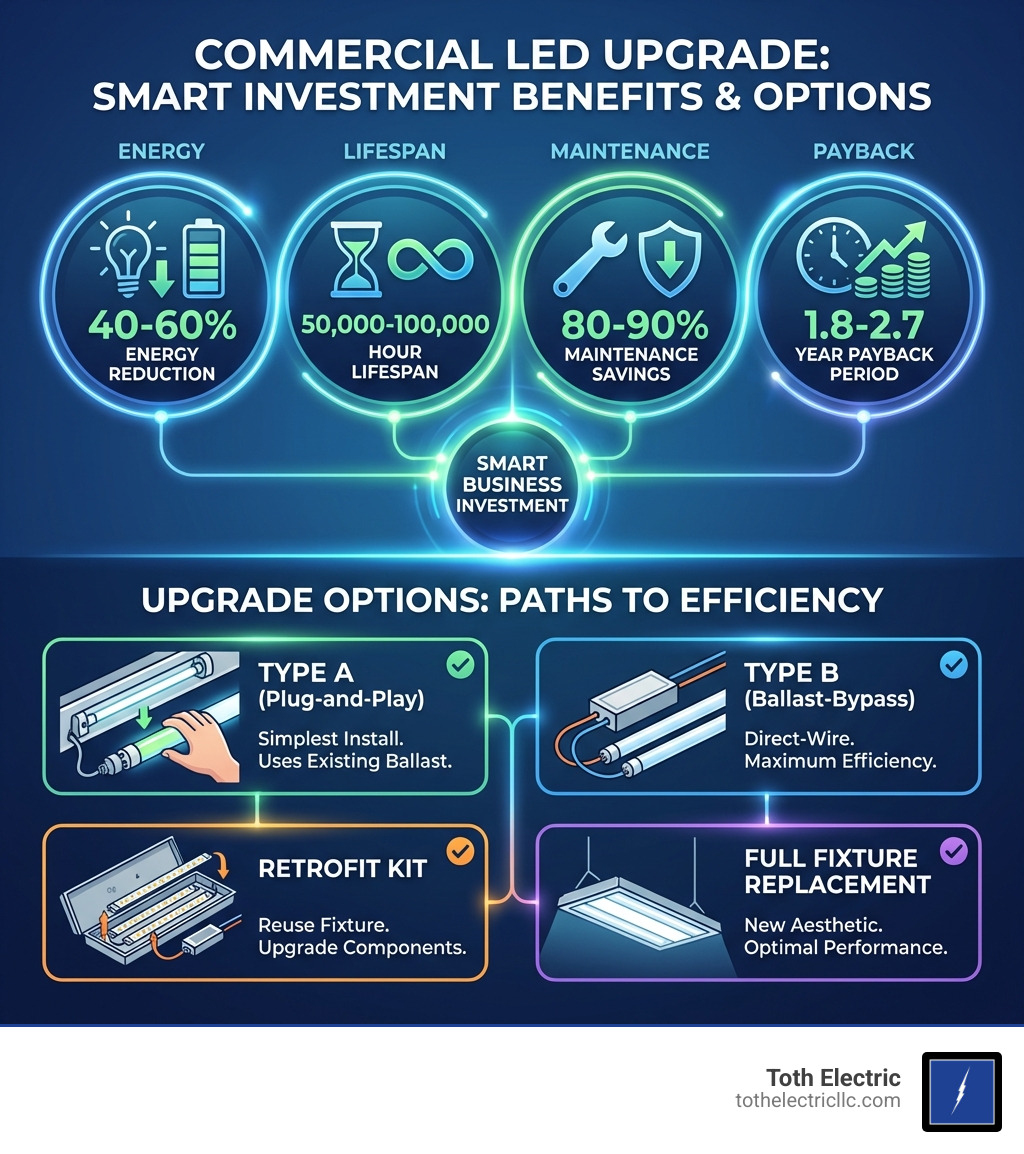
A commercial LED lighting upgrade delivers three immediate benefits that impact your bottom line: dramatic energy savings (typically 40-60% reduction in lighting costs), minimal maintenance requirements (LEDs last 50,000-100,000+ hours), and improved workplace safety through better light quality. Here's what you need to know:
Key Benefits of LED Upgrades:
- Energy Savings: 75-90% more efficient than traditional lighting
- Maintenance Reduction: 80-90% drop in maintenance costs
- Lifespan: 15 times longer than fluorescent or metal halide bulbs
- Payback Period: Often 1.8-2.7 years with typical ROI exceeding 450% over 10 years
- Light Quality: Higher CRI (80+) and instant-on brightness improve safety and productivity
Upgrade Options Available:
- Type A (ballast-compatible): Plug-and-play replacement
- Type B (ballast-bypass): Direct-wire for maximum efficiency
- Retrofit kits: Reuse existing fixtures with new LED components
- Complete fixture replacement: Modern aesthetics with optimal performance
Lighting accounts for roughly 20% of electricity consumption in commercial buildings across the United States. With over 350 million fluorescent fixtures still in operation, the opportunity for energy and cost savings through LED retrofits is substantial. Yet many property owners hesitate, uncertain about which retrofit option makes sense for their facility or how to calculate the real return on investment.
The reality is straightforward: LED technology has matured to the point where upgrades nearly always make financial sense. Businesses upgrading from older fluorescent or high-intensity discharge (HID) lighting typically see energy reductions of 40-60%, with some facilities achieving savings of $50,000 or more annually. When you factor in reduced maintenance calls—LEDs can last 6-12 years depending on operating hours—the business case becomes even stronger.
Whether you're managing a warehouse with high bay fixtures, an office building with troffer panels, or a retail space with specialized lighting needs, understanding your options helps you make an informed decision that balances upfront costs with long-term operational savings.
The Business Case for a Commercial LED Lighting Upgrade
When we talk to business owners in Northern NJ, the conversation usually starts with the monthly utility bill. It’s no secret that traditional lighting is an energy hog. Old-school incandescent bulbs release up to 90% of their energy as heat, and even "efficient" fluorescent tubes lose a significant amount of energy to the ballasts required to run them.
A commercial LED lighting upgrade flips the script by being 75-90% more efficient than traditional lighting. This isn't just a win for the environment; it's a massive win for your cash flow. Beyond the meter, maintenance costs drop by a staggering 80-90%. Imagine not having to hire a contractor with a scissor lift every few months to replace a flickering high bay bulb 30 feet in the air.
According to the U.S. Department of Energy (DOE) on LED savings, widespread adoption of LEDs by 2027 could save enough electricity to power 44 large power plants.
Comparison: LED vs. Traditional Lighting
| Feature | LED Technology | Metal Halide (HID) | Fluorescent (T12/T8) |
|---|---|---|---|
| Lifespan | 50,000 - 100,000+ Hours | 6,000 - 15,000 Hours | 10,000 - 20,000 Hours |
| Wattage (Equiv.) | 150W | 400W | 131W (4-lamp troffer) |
| Heat Emission | Very Low | High | Moderate |
| Warm-up Time | Instant-On | 10-20 Minutes | Flickers at start |
| Maintenance | Minimal (10+ years) | Frequent bulb/ballast swaps | Regular tube replacement |
Energy and Cost Savings Projections
The numbers behind a commercial LED lighting upgrade are often the most persuasive part of the guide. On average, commercial buildings see a 40-60% reduction in lighting-related energy consumption immediately after a retrofit.
For a 50,000 sq. ft. warehouse operating 24/7, the transition to energy efficiency can result in yearly savings of over $52,000. In another real-world scenario, replacing 100 metal halide fixtures (400W) with 150W LED versions can slash $12,000 off an annual energy bill. When you add in the maintenance savings—which average about $7,360 annually for a 100-fixture setup—the investment pays for itself in record time.
Improved Workplace Productivity and Safety
While the accountants love the savings, the operations team will love the light quality. Traditional HID lights often have a low Color Rendering Index (CRI), making colors look muddy and increasing eye strain. LEDs typically offer a CRI of 80 or higher, which is vital for visual accuracy in commercial electrical environments like manufacturing or retail.
Furthermore, LEDs eliminate the "strobe effect" and buzzing sounds associated with failing fluorescents. Better visibility leads to fewer accidents, higher employee morale, and an 8% increase in sales for retail environments due to better merchandise visibility.
Understanding Retrofit Options: Type A, Type B, and Hybrid Solutions
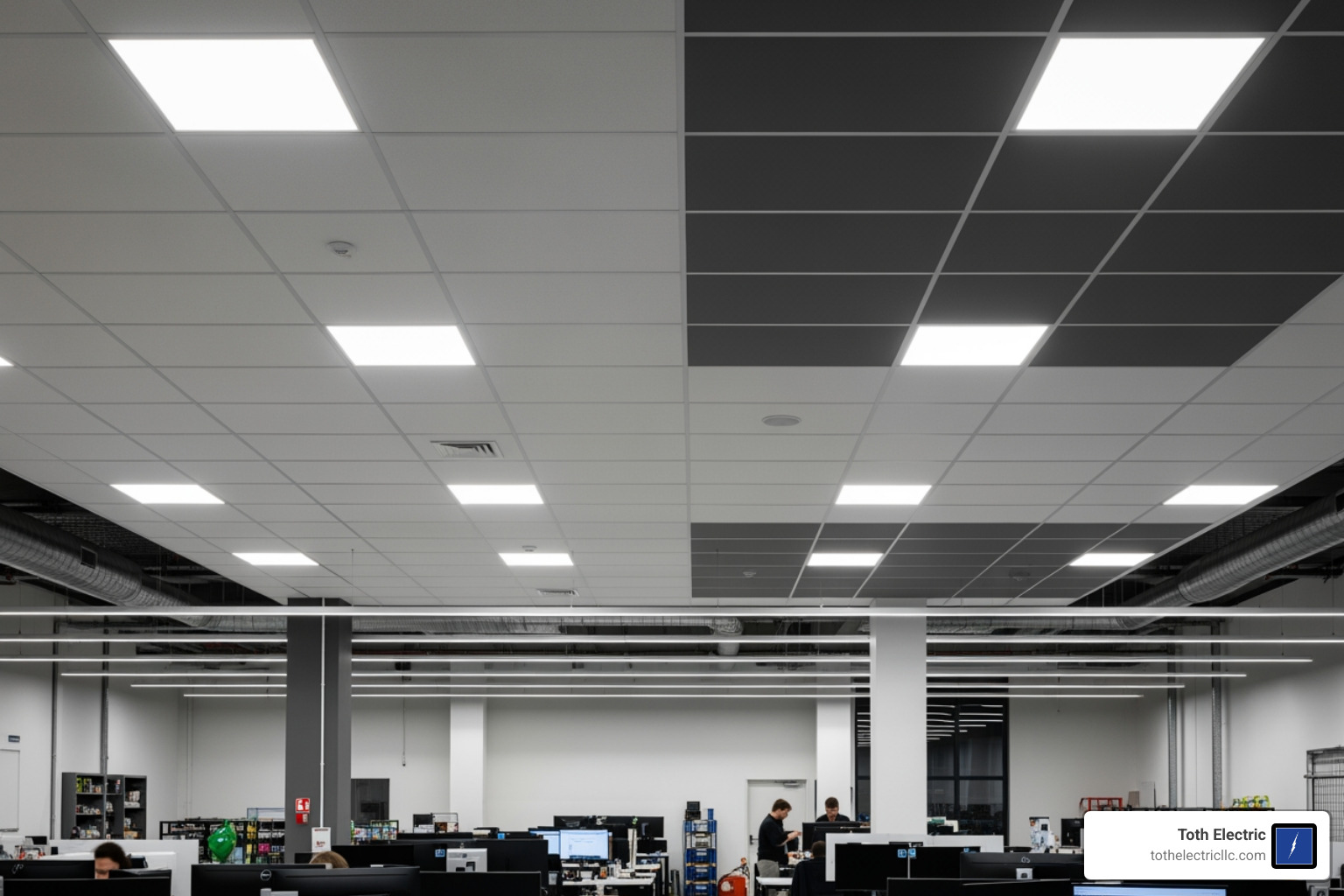
One of the biggest hurdles for businesses is deciding how to upgrade. You don't always have to rip out every fixture. There are several paths to achieving a commercial LED lighting upgrade, ranging from simple bulb swaps to full-scale architectural changes.
Ballast-Compatible (Type A) vs. Ballast-Bypass (Type B)
Type A (Plug-and-Play): These are the easiest to install. You simply swap the old tube for an LED tube. They work with your existing fluorescent ballast.
- Pros: Lowest labor cost; no rewiring.
- Cons: If the old ballast fails (and it eventually will), the light goes out. You're also still losing energy to that ballast.
Type B (Ballast-Bypass): This requires our commercial electricians to remove or "bypass" the existing ballast and wire the sockets directly to the building's line voltage (120-277V).
- Pros: More efficient (saves an extra 5-10% energy); eliminates ballast maintenance forever.
- Cons: Higher initial labor cost; requires professional installation for safety.
The Benefits of Hybrid and Type C LED Systems
If you want the "best of both worlds," Hybrid (Type A/B) lamps are available. They work with a ballast initially but can be direct-wired if the ballast fails down the road.
For those seeking maximum performance, Type C systems use an external LED driver. This is similar to how a ballast works but is specifically engineered for LEDs, offering the best thermal management and the easiest integration with smart dimming controls.
Lamp Replacement vs. Full Fixture Replacement
Should you just change the "bulb" or the whole "box"?
- Lamp/Tube Replacement: Best for businesses on a tight budget with fixtures in good physical condition.
- Retrofit Kits: A middle ground where you gut the existing fixture and install a new LED plate and driver. This is great for lighting installation in custom or ornate fixtures you want to keep.
- Full Fixture Replacement: Recommended for aging facilities where the housings are yellowed, cracked, or inefficient. This offers the best aesthetic and optical performance.
Planning Your Commercial LED Lighting Upgrade: A Step-by-Step Process
At Toth Electric, we believe that "doing the job right" starts with a solid plan. A haphazard upgrade can lead to over-lighting (which wastes money) or under-lighting (which is a safety hazard).
Step 1: Conduct a Comprehensive Lighting Audit
Before buying a single bulb, you need to know what you have. Our commercial LED retrofitting services start with an audit that documents:
- Fixture counts and types.
- Current wattage and operating hours.
- Light levels (measured in footcandles) to ensure we meet OSHA standards.
- Condition of existing wiring and ballasts.
Step 2: Selecting the Right Products for Your Space
Not all LEDs are created equal. For industrial spaces, we look for:
- Efficacy: Aim for 120-130 lumens per watt (lm/W).
- DLC Listing: The DesignLights Consortium (DLC) certifies high-quality commercial LEDs. Most utility rebates require DLC-listed products.
- CCT and CRI: Choosing the right "color" of light for your specific warehouse and industrial lighting design and installation is crucial for productivity.
Step 3: Professional Installation and Disruption Management
We know your business can't just stop because the lights are being changed. We manage the lighting upgrades process by:
- Phased Implementation: Working section by section.
- Off-Hours Scheduling: Performing work during nights or weekends to stay out of your way.
- Safe Disposal: Properly recycling old fluorescent tubes that contain mercury—a critical step for environmental compliance.
Technical Specifications: Lumens, CCT, and CRI for Industrial Spaces
Understanding the "language" of lighting helps you make better choices. The U.S. Energy Information Administration (EIA) on commercial lighting notes that lighting is one of the most significant energy uses in commercial buildings, so getting the specs right is key.
Understanding Lumens and Efficacy
In the old days, we bought bulbs by "wattage." Today, we buy by lumens (brightness). Efficacy is simply how many lumens you get for every watt of power used. High-performance LEDs achieve 120+ lm/W, whereas old metal halides might only net 75 lm/W once you account for the light absorbed by the fixture itself.
Choosing Color Temperature (CCT) and Color Rendering (CRI)
- CCT (Correlated Color Temperature): Measured in Kelvin (K).
- 3000K: Warm (good for hospitality).
- 4000K: Neutral (perfect for offices).
- 5000K: Daylight (ideal for warehouses and manufacturing).
- CRI (Color Rendering Index): A scale of 0-100. For most commercial spaces, a CRI of 80+ is the standard, ensuring colors are vivid and accurate.
Integrating Smart Controls and Sensors
The real "magic" happens when you add controls. Pairing a commercial LED lighting upgrade with occupancy sensors or daylight harvesting (lights that dim when the sun is shining through windows) can deliver an additional 20-40% savings.
Maximizing ROI for Your Commercial LED Lighting Upgrade
Money talks. The average payback period for a commercial retrofit is between 1.8 and 2.7 years. That means by the end of year three, the upgrade has paid for itself, and every dollar saved after that goes straight to your bottom line. Over 10 years, the ROI can reach a staggering 453%.
Utility Rebates and 179D Tax Deductions
To sweeten the deal, there are several financial incentives available:
- Utility Rebates: Many NJ utilities offer "instant discounts" or prescriptive rebates that can cover a significant portion of the material costs.
- 179D Tax Deduction: This federal deduction allows for up to $5.00 per square foot for buildings that significantly reduce energy use through lighting and other systems.
- ENERGY STAR: Always look to Upgrade Your Lighting with Energy Star certified products to ensure you qualify for these programs.
Financing Options and Lighting as a Service (LaaS)
Don't have the capital upfront? No problem.
- Leasing Models: Spread the cost over several years.
- Lighting as a Service (LaaS): Some providers offer zero-capital upgrades where you pay for the lighting as a monthly service fee, which is usually less than the money you're saving on your energy bill.
Frequently Asked Questions about Commercial LED Lighting Upgrades
How long do commercial LED lights typically last?
LEDs are rated for 50,000 to 100,000+ hours. In a typical office setting, that’s nearly 20 years of life. Compare that to metal halides which might only last 2-4 years. For a deeper look at residential vs. commercial longevity, see our energy efficient lighting guide.
What is the difference between a retrofit kit and a new fixture?
A retrofit kit keeps the existing metal "box" (housing) but replaces the guts with LEDs. A new fixture is a complete replacement. Kits are often cheaper and faster to install if the existing housings are in good shape.
Can I install LED retrofits myself?
While "plug-and-play" bulbs seem easy, commercial installations often involve high voltages (277V or 480V) and complex wiring. To ensure code compliance and avoid fatal shock hazards, it is always best to hire a licensed professional.
Conclusion
Upgrading your facility's lighting isn't just about changing bulbs; it's about making a strategic investment in your business's future. At Toth Electric, we’ve spent years helping businesses throughout Northern New Jersey—from Jersey City to Morristown and Newark—realize the massive benefits of high-efficiency lighting.
As a licensed electrical contractor, we take pride in doing the job right and treating people right. We ensure every commercial LED lighting upgrade we perform is safe, code-compliant, and optimized for maximum savings. Whether you're in Maplewood, Montclair, or Union, we're ready to help you flip the switch on a brighter, more efficient workspace.
Ready to see how much you could save? Get started with Commercial LED Retrofitting Services today and let us help you light the way to a more profitable future.
Read Our Best Articles


Serving Communities Throughout Northern New Jersey
Mountain Lakes, South Orange, West Orange, Mountainside, Morristown, Maplewood, New Providence, Newark, Union County, Montclair, Verona, and surrounding Northern New Jersey communities.


